
Safety shoes are an essential part of workplace safety in many work environments. When choosing them, it is important to consider both the requirements of the work environment and personal needs. This article discusses how to choose the right safety shoes and what the different protection ratings mean.
Safety shoes protect feet from a wide range of hazards, such as falling and sharp objects, chemicals, and moisture. They can also help prevent slips and provide support on uneven surfaces. Certain jobs require shoes with a specific safety rating, and choosing the correct rating is an essential workplace safety matter.
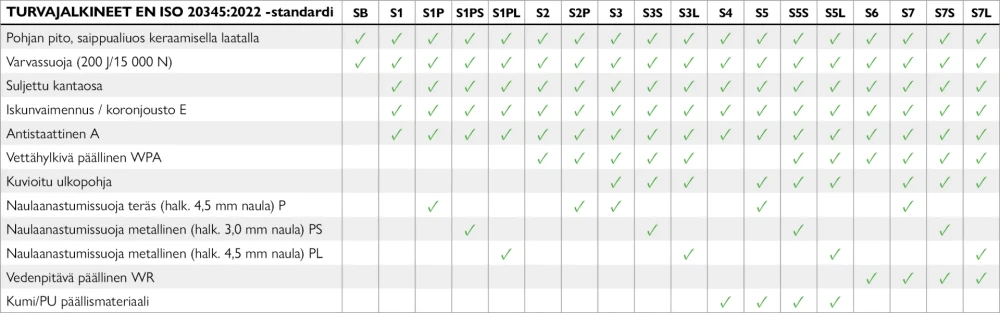
Safety shoe protection ratings are standardized in the EU (EN ISO 20345:2022), and they help identify the level of protection the shoes provide. The new safety footwear standard EN ISO 20345:2022 has replaced the previous EN ISO 20345:2011 standard. The transition period lasts until the end of 2027, so products certified according to both the new and old standards are available on the market.
The most common protection classes are S1, S1P, S2, and S3
- S1: This rating includes a toe cap, antistatic properties, a closed heel, and an oil-resistant sole. S1-rated shoes are suitable, for example, for warehouse and service personnel.
- S1P: In addition to the features of S1, the S1P rating includes penetration resistance, which protects against sharp objects.
- S2: S2-rated shoes have the same features as S1 shoes, but they are also water-resistant.
- S3: This rating offers maximum protection, including a toe cap, penetration resistance, water resistance, and a treaded sole that improves grip.
Additional features (testing not mandatory)
- SR: Sole grip on ceramic flooring with glycerol
- LG: Sole grip on ladders
- FO: Outsole resistant to oil and fuel
- HRO: Heat-resistant sole up to 300°C
- HI: Heat insulation of the sole
- CI: Cold insulation of the sole
- SC: Abrasion protection in the toe area
- M: Metatarsal protection
- AN: Ankle protection
- CR: Cut resistance of the upper
When choosing safety shoes, it is important to consider the specific requirements of the work environment. For example, construction sites often require S3-rated shoes, which provide comprehensive protection and good grip. On the other hand, S1-rated shoes may be sufficient for warehouse workers, as they offer basic protection and are lighter. So choosing an "overly safe" shoe (that is, selecting S3 when S1 is sufficient) is not necessarily sensible, because in addition to price, other shoe features may better match the demands of the job.
Summary
Choosing the right safety shoes is an important part of workplace safety. Knowing the protection ratings helps you select shoes that are suited to your specific work environment. Always remember to check your workplace requirements and choose shoes that provide the necessary protection and comfort.