
DIN934 vs DIN6932 Hex Nuts
A nut without a flange (Figure 1) is commonly used in the assembly of machines and equipment.
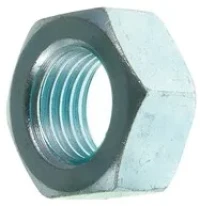
Figure 1: Hex Nut DIN934DIN934 10 Zn
A flange refers to the part of the nut that resembles a washer (Figure 2). The products shown in Figures 1 and 2 should always be used in screw-and-nut connections to reduce friction during tightening.
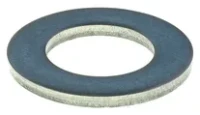
Figure 2: Washer DIN125DIN125 A2
In a flanged DIN6923 nut, the flange (washer) is an integral part of the nut (Figure 3).
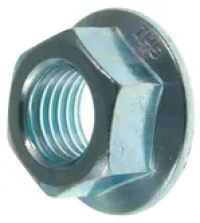
Figure 3: Flange Nut DIN6923DIN6923 Zn
The same tightening result can be achieved with a nut + washer combination as with a DIN6923 nut. When tightening a DIN6923 nut, friction between the screw head and the part being tightened must be taken into account. In a DIN6932 nut, the flange (washer) is fixed, so it does not flex during tightening. For example, in electrical connections where wires are fastened to conductors, the wire may twist in the tightening direction when a DIN6932 nut is tightened. This happens less often when using a DIN934+DIN125 combination. In addition, the tightening torque of the screw joint is easier to achieve with a DIN934+DIN125 combination than with a DIN6932 nut, although the difference is not significant.
DIN6932 nuts are available in both smooth and serrated versions. Serrations on the outer surface of the flange help prevent the nut from loosening on its own (Figure 5). The serration is usually indicated after the standard, for example DIN6932-R.
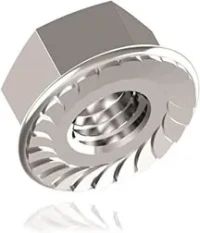
Figure 4: DIN6932-RHDIN6932 R
Among the advantages of DIN6932 nuts are fast installation, easy removal, and simple reinstallation during maintenance. In some applications, a DIN6932 hex nut is also a more aesthetically pleasing solution.