
In Finland, the fastener market is mainly based on metric threads. Our neighboring country Sweden has partly influenced the use of inch threads, and from the 1900s to the 1990s, inch-threaded fasteners were used in machine building in Finland. Inch-threaded fasteners were especially favored in Finland’s Swedish-speaking regions. The location of machine shops and manufacturing in Sweden also increased the use of these fastening products in Finland. Machine shops in inland areas mostly used metric-threaded fasteners, although fastener suppliers also imported products from Sweden. In the 2000s, the use of inch threads has decreased significantly, and today inch-threaded fasteners are mainly used in machines and equipment manufactured in England and the USA.
If the country of manufacture of a machine is unknown, it can be challenging to know whether it uses UNF, UNC, or metric-threaded fasteners. It is difficult to tell the difference by sight, although a trained eye may recognize the difference in thread pitch. The markings on the fastener head can also provide clues. The easiest way is to interpret the head markings (Read the resource article: What does the fastener head tell you?). If the head is worn or unclear, you can compare it with a metric-threaded fastener of the same approximate diameter. Most commonly, fine inch thread UNF is confused with a fine metric-threaded fastener.
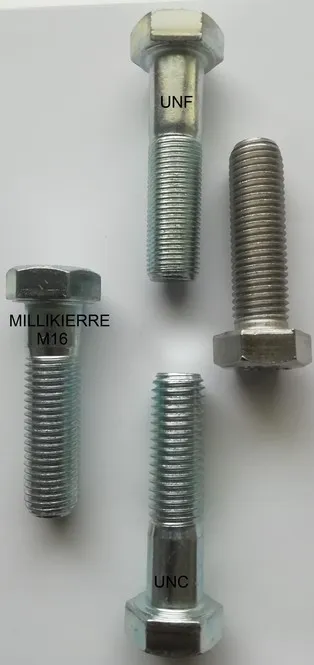
The image shows UNF and UNC hex bolts together with two metric-threaded hex bolts in size M16 with standard thread pitch. The inch-threaded hex bolts in the image have a diameter of 5/8 inch, which corresponds to 15.875 mm. The thread diameters of the products are nearly the same for both metric and inch-threaded fasteners. Visually, the metric thread is coarser than UNF (fine inch thread). UNC (coarse inch thread) has a wider pitch than the metric thread.
Another way is to measure the diameter of the threaded section. In the example fastener shown, it is under 16 mm (15.875 mm), whereas on the metric-threaded fastener it is almost exactly 16 mm (approx. 15.98 mm). A third way is to measure the width across flats of the fastener, meaning the wrench size used to loosen or tighten it. The width across flats of the inch-threaded fastener in the image is about 23.5 mm, whereas the metric-threaded fastener has a width across flats of 24 mm.
If it is known that a machine, vehicle, or similar item was manufactured in England or the USA, it is very likely that inch-threaded fasteners were used. There are many ways to distinguish inch thread from metric thread, but there is no single 100% certain method without a thread gauge. The easiest way to identify inch thread is from the markings on the head of a hex bolt, but with a socket head screw it is a bit more challenging.