
A bolted joint can be tightened in two ways: either by turning the nut or by stretching the bolt until the required preload is achieved.
The most common method is to tighten the bolt by turning the nut. When the joint is tightened by turning the nut, it is subjected not only to tensile stress but also to torsional stress, which must be taken into account when dimensioning the joint. The presence of torsional stress in the joint reduces the maximum allowable tensile stress—that is, the bolt’s load-carrying capacity—the more so the greater the torsional stress.
The magnitude of the torsional stress is affected by the axial tensile force in the bolt and the coefficient of friction. The tensile force cannot be influenced, since the joint must be tightened sufficiently; otherwise, the joint may open, and in dynamically loaded cases the stress amplitude will increase. If tightened too much, the joint may also loosen if tightening has been carried out up to the yield point, or it may even cause the joint to fracture under external load. In extreme cases, the joint may fail already during the preloading stage.
The coefficient of friction, however, can be influenced. The lower it can be made, the more the bolt can be tightened axially.
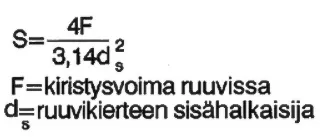
The stresses in the bolt during tightening are calculated as follows:
Tensile stress caused by the tightening force:
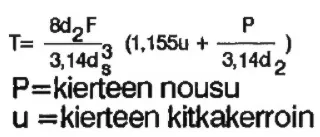
Torsional stress caused by the torque:
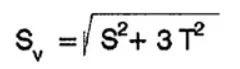
The reduced combined effect of these two stresses is calculated using the distortion energy theory:
If, after tightening, the joint is subjected to external forces that cause tensile or torsional stresses, these must also be taken into account so that the joint is not tightened too much during the preloading stage, as this may cause the joint to fracture.