Choosing a fastener according to its intended application can help save costs. If a lower-strength fastener is suitable for the application, it is worth selecting that option. When determining the required strength, it is important to perform strength calculations to define the tensile and shear forces acting on the joint and the fastener. Software programs and tables are available to help with these calculations. For the most demanding applications, technical engineering firms can assist in determining the correct strength requirements for bolted joints.
During maintenance repairs, screw fasteners are usually replaced with new ones. In these cases, it is important to understand and follow the information marked on the fastener. In older equipment, the screws may not have markings to interpret, the markings may have worn away, or the fastener may be rusted so badly that the information is no longer legible. For example, in vehicle chassis structures, fasteners are often worn over time and the markings are no longer visible. Here are a few things to keep in mind with hex-head screw fasteners.
Fastener heads
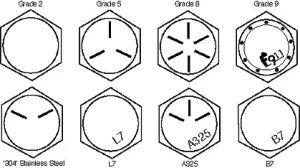
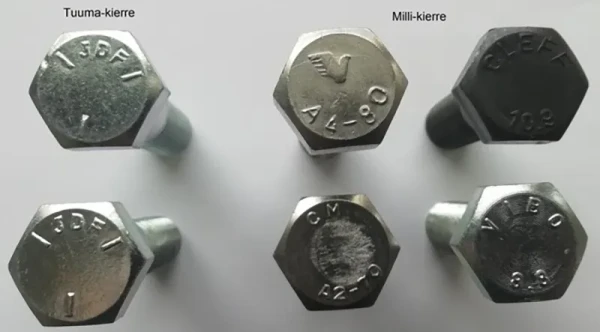
On the left side of the image are inch-threaded UNF and UNC bolts. The head marking JDF is the manufacturer's mark. Three lines extending outward from the inner circle indicate the fastener’s hardness, which in this case is Gr.5. In metric-thread terms, this corresponds to strength class 8.8, commonly referred to as grade 8. If there were six lines extending outward from the inner circle on the head, the fastener would be Gr.8, which corresponds roughly to metric strength class 10. The most common strength grade on the market is Gr.5.
In the center of the image are metric-thread stainless hex bolts. The upper embossed marking is the manufacturer's logo. A4 means acid-resistant material, and -80 indicates the material strength, which is approximately equivalent to grade 8. The lower bolt marking CM is the manufacturer's mark. A2 means stainless steel, and -70 indicates the strength of the bolt material, which is approximately equivalent to grade 7. On the right side are metric-thread hex bolts. The upper one is strength class 10.9 and the lower one is 8.8. CLEFF and VIBO are manufacturer marks. In everyday terms, the upper one is grade 10 and the lower one is grade 8. Grade 10 fasteners are usually uncoated. When zinc-plated, a grade 10 fastener loses some of its strength because the fasteners undergo hydrogen embrittlement relief treatment. This only occurs if a high-strength fastener is bright zinc-plated or passivated. If a high-strength fastener is coated with, for example, a zinc flake coating, hydrogen embrittlement relief treatment is not required, and the fastener therefore retains its standard strength.
As a general rule, if you replace a screw fastener during maintenance, always replace it with one that matches the original. In vehicle braking systems, such as brake calipers and brake discs, at least grade 10 fasteners are generally used. Some lighter vehicles may use grade 8 fasteners. Fasteners for brake discs, for example on motorcycles and mopeds, must not be replaced with lower-grade fasteners of weaker strength. Especially on two-wheeled vehicles, where the brake discs and their fasteners are highly visible, it is common for people to want to replace the fasteners with stainless fasteners so they will not rust. However, stainless or acid-resistant fasteners are too weak for this kind of application (strength A2-70 or A4-80 versus steel fastener 10.9). In the worst case, the fasteners may fail and cause a serious accident.
Head markings on hex screws for inch-size fasteners